- +90 212 640 55 86
- Mon - Fri: 09:00 - 18:00
- info@ebiexport.com

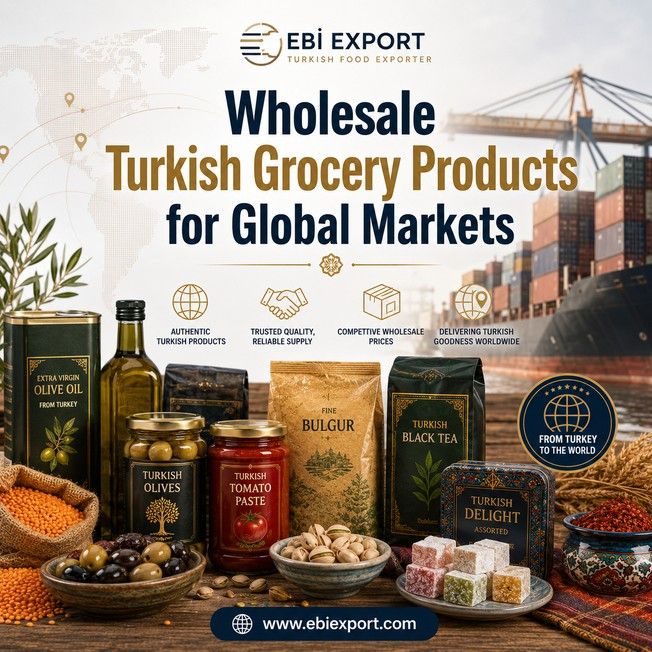
The demand for wholesale Turkish grocery products continues to grow in global markets. Importers, distributors, ethnic grocery chains, supermarkets, restaurants, hotels, and food service companies are looking for reliable Turkish products that can meet both traditional taste expectations and modern retail standards.
Turkiye has a strong place in food trade because it offers a wide product range. From Turkish olives and kadayif to legumes, pickles, spices, sauces, dried foods, sweets, bakery ingredients, and pantry products, Turkish grocery categories can serve many different sales channels.But wholesale grocery supply is not only about filling a container with products. The real matter is choosing the right products, preparing them in the right packaging, managing documents correctly, and building a supply process that can be repeated without chaos. In food export, one good shipment is pleasant. Ten stable shipments are business.
Why Turkish Grocery Products Are Attractive for Global Buyers
Turkish grocery products are attractive because they carry both cultural value and commercial flexibility. Many Turkish foods are already familiar in Mediterranean, Middle Eastern, Balkan, European, and ethnic food markets. This makes them easier to introduce to consumers who are already open to traditional and regional flavors.For global buyers, Turkish grocery products can be positioned in several ways. Some products are suitable for premium retail shelves. Some are ideal for ethnic markets. Some work better for restaurants, bakeries, catering companies, or bulk food service supply.
A jar of olives, a pack of kadayif, a bag of legumes, or a traditional sauce may look simple at first glance. But each product has its own market logic. The same product can be sold as a retail item, food service ingredient, private label product, or wholesale bulk supply. That flexibility gives Turkish grocery products a strong advantage.
Key Turkish Grocery Categories for Wholesale Supply
When sourcing Turkish grocery products wholesale, buyers should first understand which categories fit their market. Not every product is suitable for every country, and not every packaging type works for every sales channel.Turkish olives are one of the strongest grocery categories. They can be supplied in jars, tins, vacuum packs, buckets, or bulk formats. Importers can target supermarkets, delicatessens, ethnic grocery stores, hotels, restaurants, and food distributors. Olive variety, size, brine level, packaging type, and taste profile should be selected carefully.
Turkish kadayif is another valuable product group for global food buyers. It can serve bakeries, dessert producers, restaurants, wholesalers, and distributors focused on Turkish, Middle Eastern, Mediterranean, and Balkan cuisine. Product format, freshness, storage condition, and packaging size are important details.Legumes and pulses are practical grocery products because they are widely consumed, easy to store, and suitable for many cuisines. Lentils, chickpeas, beans, and bulgur-style products can be attractive for both retail and wholesale distribution.
Pickles and preserved foods are also strong in Turkish grocery supply. These products often appeal to ethnic markets, Mediterranean food stores, restaurants, and supermarket sections focused on international foods.Sauces, pastes, and pantry products can support both retail and food service channels. Tomato paste, pepper paste, tahini, molasses, vinegar-based products, and similar grocery lines can create repeat purchase potential when quality and packaging are stable.
Spices and dried ingredients are useful for buyers who want compact, shelf-stable, and easily distributable products. These categories require careful packaging, aroma protection, and clear labeling.
What Global Importers Expect from a Turkish Grocery Supplier
A professional Turkish grocery supplier must understand that international buyers need more than a price list. Buyers need clarity. They want to know what they are buying, how it is packed, when it can be shipped, which documents are available, and whether the same quality can be supplied again.A reliable supplier should provide clear product information, stable communication, realistic lead times, and export-ready packaging. Nice words are not enough. A buyer cannot clear customs with compliments.
Importers usually expect support in product selection, private label planning, wholesale packaging, mixed shipment preparation, documentation, and logistics coordination. These are not side details; they are the structure of the trade.If a supplier cannot explain shelf life, carton dimensions, pallet structure, minimum order quantity, product specifications, or export documents clearly, the buyer should slow down. In wholesale food trade, uncertainty is not romantic. It is expensive.
Retail, Food Service, and Bulk Supply Differences
Wholesale Turkish grocery products can be prepared for different sales models. The product may be the same, but the business model changes everything.Retail grocery supply focuses on shelf appeal, barcode structure, label language, packaging design, expiry date format, nutritional information, and consumer trust. Retail packaging must look clean, professional, and suitable for the target market.
Food service supply is usually more practical. Restaurants, hotels, bakeries, and catering companies often care more about usage size, storage convenience, consistency, and cost efficiency. Packaging may be larger and simpler, but quality must still be stable.Bulk supply is suitable for distributors, manufacturers, and large-volume buyers. Here, pricing, shipment efficiency, product consistency, and packaging strength become more important.
A good Turkish food wholesaler should not offer the same solution to every buyer. Trade is not a one-size-fits-all shirt. It needs proper measurement.
Export-Ready Packaging for Turkish Grocery Products
Packaging is one of the most important parts of grocery export. It protects the product, supports shelf life, affects logistics, and builds buyer confidence. Even a high-quality product can lose value if the packaging is weak.For retail products, packaging must be visually suitable and legally prepared for the target market. For wholesale and food service products, packaging must be strong, practical, and efficient. For long-distance shipments, carton quality and pallet planning become even more important.
Buyers should check packaging sizes, inner packs, outer cartons, label language, barcode needs, production date, expiry date, storage instructions, and private label options before placing an order.Poor packaging can turn a good product into a customs problem, a warehouse problem, or a customer complaint. That is why packaging should never be treated as an afterthought. In export, the box is not just a box. It is the product’s armor.
Private Label Turkish Grocery Products
Many global buyers prefer private label Turkish grocery products because they want to build their own brand in their market. This can be a strong option for supermarkets, distributors, ethnic grocery chains, gourmet stores, and importers with established sales channels.Private label supply may include olives, sauces, pickles, dry foods, sweets, kadayif, pantry products, and other grocery categories. However, private label work requires more preparation than standard wholesale purchasing.
Buyers need to plan label design, product name, ingredient information, barcode, nutritional details, target language, packaging size, carton structure, and minimum order quantity. The supplier must also confirm production timing and packaging availability.Private label can create long-term value, but it is not a shortcut. A weak product with a nice label is still a eak product. The old rule stands: silk wrapping does not turn a stone into bread.
Quality Control in Wholesale Grocery Export
Quality control is central to Turkish grocery export. Buyers should evaluate not only taste but also consistency, packaging condition, shelf life, batch control, label accuracy, weight stability, and storage standards.For olives, quality control may include variety, size, color, texture, salt level, brine quality, and packaging condition. For kadayif, it may include freshness, texture, moisture balance, storage method, and usability for desserts or bakery production.
For dry grocery products, moisture level, packaging seal, product cleanliness, and shelf stability become important. For sauces and preserved foods, flavor consistency, jar or tin quality, vacuum condition, and expiry control must be checked carefully.A serious buyer should not rely only on attractive product photos. Photos can open the door, but specifications close the deal. Samples, technical details, and supplier transparency are much stronger than a beautiful catalog.
Documentation and Export Process
Food export requires accurate documentation. The exact documents may change depending on the product and destination country, but importers usually need commercial invoice, packing list, certificate of origin, product specifications, shelf life information, and other food-related documents requested by local authorities or customs brokers.This process should be discussed before shipment. Waiting until the goods are ready is risky. Documentation is not paperwork dust; it is the passport of the product.
A professional Turkish grocery exporter should be able to explain which documents can be prepared and which details the buyer must confirm locally. The importer should also check requirements in the destination country before finalizing the order.
Building Long-Term Wholesale Supply from Turkiye
The strongest wholesale relationships are built on repeat orders, not one-time shipments. For global buyers, the real value is not only finding Turkish grocery products, but finding a supplier who can provide them consistently.Ebi Export works with international buyers looking for wholesale Turkish grocery products from Turkiye. The focus is on reliable sourcing, export-ready preparation, clear communication, and product solutions suitable for global markets.
For importers interested in Turkish olives, Turkish kadayif, and other grocery categories, a structured sourcing process can make trade easier and safer. The supplier should understand the product, the buyer’s market, and the export process together.Global grocery trade rewards discipline. Good products matter, but good planning carries them across borders. With the right sourcing approach, Turkish grocery products can reach retail shelves, restaurant kitchens, food service warehouses, and distributor networks with stronger commercial value.
Turkiye offers rich food categories, experienced production, and strong export potential. Ebi Export helps international buyers turn that potential into a practical wholesale supply process shaped around quality, packaging, documentation, and long-term cooperation.