- +90 212 640 55 86
- Mon - Fri: 09:00 - 18:00
- info@ebiexport.com

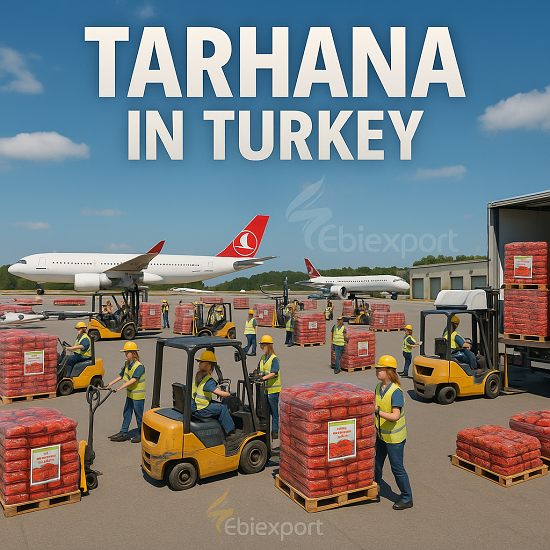
Tarhana exports from Turkey refer to the international distribution of tarhana, a traditional fermented food product produced in Türkiye and supplied to global markets in various formats. While tarhana is deeply rooted in Anatolian food culture, its export potential has expanded significantly due to growing global interest in fermented, shelf-stable, and nutritious foods.
Unlike many instant soup products, tarhana is based on a natural fermentation process. This characteristic makes tarhana exports from Turkey especially attractive to markets seeking authentic, clean-label products with long shelf life. As consumer awareness around traditional and functional foods increases, tarhana is no longer viewed as a regional specialty but as a global food category.
This shift has positioned Türkiye as the primary and most reliable source for export-grade tarhana products.
International food markets are increasingly driven by demand for products that combine tradition, nutrition, and practicality. Tarhana exports from Turkey align perfectly with this trend. Tarhana offers a unique combination of fermented grains, yogurt, vegetables, and herbs, resulting in a nutritionally dense product that is easy to prepare.
Global consumers are becoming more familiar with fermented foods due to their perceived digestive benefits and natural preservation methods. Tarhana fits this narrative without requiring artificial additives. Its powdered or granulated form allows for convenient transport and storage, a major advantage in international trade.
These factors collectively strengthen the position of tarhana exports from Turkey in both retail and food service markets.
Tarhana production in Türkiye is not a recent development. It is the result of centuries-old practices refined across different regions. Each region historically developed its own variation, adjusting ingredients and fermentation times based on local conditions.
For tarhana exports from Turkey, these traditional methods are adapted to modern production standards. Fermentation remains a core process, but it is now controlled and standardized to ensure consistency across batches. This balance between tradition and technology allows Turkish producers to preserve authenticity while meeting international quality expectations.
Export-grade tarhana reflects this dual identity, offering both heritage and reliability.
The production of export-oriented tarhana begins with carefully selected raw materials. Wheat flour or cracked wheat, yogurt, tomatoes, peppers, onions, and spices form the base. Ingredient quality directly impacts flavor stability and shelf life.
During fermentation, the mixture is left to develop under controlled conditions. This stage is critical for flavor formation and microbial stability. In tarhana exports from Turkey, fermentation parameters are monitored to avoid inconsistencies that could affect export performance.
After fermentation, the mixture is dried and ground into powder or granules. Drying techniques are designed to preserve aroma while ensuring moisture levels suitable for long-distance transport.
Export markets demand flexibility. Tarhana exports from Turkey are available in multiple forms to meet different usage scenarios. Powdered tarhana is the most common format, offering ease of use and fast preparation.
Granulated tarhana provides controlled portioning and is favored in institutional kitchens. Some exporters also develop instant tarhana blends adapted for modern retail consumers, combining tradition with convenience.
Regardless of format, consistency in texture and flavor is essential. Export buyers expect the same performance in every shipment.
Taste alone does not define export quality. Tarhana exports from Turkey must meet strict technical criteria, including moisture content, microbial safety, and shelf stability. These parameters are essential for compliance with international food regulations.
Producers implement quality control systems that monitor each stage of production. Batch testing ensures that tarhana maintains its characteristic sourness without developing off-flavors. Packaging solutions are selected to protect the product from humidity and light exposure.
These measures ensure that tarhana arrives at its destination with its integrity intact.
European countries represent a significant share of tarhana exports from Turkey, particularly markets with established demand for ethnic and traditional foods. Clean labeling and regulatory compliance are major priorities in these regions.
Middle Eastern markets value tarhana for its long shelf life and ease of preparation. In North America, tarhana is increasingly positioned as a fermented, functional food, appealing to health-conscious consumers.
Each market has distinct expectations, and Turkish exporters adjust formulations, packaging, and labeling accordingly.
Exporting food products requires adherence to a complex regulatory framework. Tarhana exports from Turkey comply with international food safety standards, including ingredient transparency and hygiene requirements.
Documentation such as certificates of origin, health certificates, and product specifications accompanies each shipment. Labeling is customized to meet destination country regulations, including language and nutritional information requirements.
This regulatory discipline strengthens Türkiye’s reputation as a professional exporter rather than a niche supplier.
Global buyers look for suppliers who can offer authenticity without compromising consistency. Tarhana exports from Turkey deliver both. The product’s cultural origin adds value, while standardized production ensures reliability.
Pricing competitiveness also plays a role. Türkiye’s integrated agricultural and food processing sectors allow exporters to maintain cost efficiency without reducing quality. This balance is difficult to replicate elsewhere.
Long-term supply capability further enhances buyer confidence.
We approach tarhana exports from Turkey as a specialized field rather than a generic food category. Every stage, from ingredient sourcing to final packaging, is managed with export performance in mind.
Only batches that meet our internal benchmarks are approved for shipment. Fermentation profiles, drying parameters, and packaging integrity are evaluated independently for each production run.
We do not merely export tarhana. We ensure that it reaches global markets in its most reliable and authentic form. This commitment defines how we operate and why our exports stand out.
Demand for traditional and fermented foods continues to grow. Tarhana exports from Turkey are well-positioned to benefit from this trend. Innovations in packaging, portioning, and product variants are expanding market reach.
Sustainability and transparency are becoming increasingly important. Turkish exporters are investing in traceability systems to meet these expectations.
As global consumers seek foods with history and substance, tarhana is likely to secure a stronger place on international shelves.
What is included in tarhana exports from Turkey?
Tarhana exports from Turkey include fermented, dried tarhana products supplied in powder or granulated form for international markets.
Is tarhana suitable for long-distance export?
Yes. Its low moisture content and stable composition make it suitable for extended storage and transport.
Which countries import tarhana exports from Turkey?
European countries, the Middle East, North America, and selected Asian markets are key destinations.
Does tarhana require special storage conditions?
It should be stored in a cool, dry environment to maintain quality over time.
Why choose tarhana exports from Turkey?
They combine authentic tradition, controlled production, competitive pricing, and export-ready quality.