- +90 212 640 55 86
- Mon - Fri: 09:00 - 18:00
- info@ebiexport.com

Sesame exports from Turkey refer to the international trade of sesame seeds sourced, processed, and supplied from Türkiye to global markets. While sesame is often viewed as a basic agricultural commodity, its role in food production, baking, and oil processing makes it a strategically valuable export product.
Türkiye has long been involved in sesame trade, not only as a producer but also as a regional hub for processing and redistribution. Today, sesame exports from Turkey serve a wide range of industries, from bakery and confectionery to ready-to-eat foods and industrial oil production.
This export activity is shaped by quality control, consistency, and the ability to meet diverse international specifications.
Sesame seeds are small in size but significant in value. Their high oil content, distinct aroma, and functional properties make them indispensable in many cuisines. Sesame exports from Turkey benefit from this global demand, which remains stable across different regions.
In bakery applications, sesame provides texture and flavor. In processed foods, it contributes nutritional value. In oil production, it offers a premium raw material. These multiple uses ensure that demand is not limited to a single sector.
Türkiye’s ability to respond to these varied needs strengthens its position in the global sesame market.
Türkiye occupies a unique position in sesame trade due to its geographic and commercial advantages. While domestic production exists, Türkiye is also known for sourcing, cleaning, processing, and re-exporting sesame seeds. Sesame exports from Turkey often reflect this integrated trade model.
Turkish exporters work with different origins and apply standardized processing techniques to meet destination market requirements. This flexibility allows Türkiye to serve as a reliable supplier even when regional harvest conditions fluctuate.
Such adaptability is essential in agricultural trade, where consistency often matters more than volume.
Raw sesame seeds cannot be exported without proper preparation. Cleaning, sorting, and quality grading are critical steps. Sesame exports from Turkey rely on modern processing facilities equipped to remove impurities and ensure uniformity.
Moisture control is particularly important. Excess moisture compromises shelf life and increases the risk of spoilage. Turkish processors apply controlled drying methods to achieve export-grade stability.
Color sorting is another key stage. Uniform color enhances visual appeal and signals quality to buyers, especially in retail and bakery markets.
Quality in sesame exports is defined by measurable parameters. These include purity level, moisture content, oil percentage, and seed uniformity. Sesame exports from Turkey are evaluated against these benchmarks before shipment.
Foreign matter tolerance is kept minimal. Seeds are screened for size consistency to meet buyer specifications. Oil content is monitored, particularly for markets focused on sesame oil production.
These technical standards ensure that sesame arrives ready for immediate use, reducing processing needs for the importer.
Sesame exports from Turkey are supplied in several forms depending on market demand. Natural raw sesame is common for industrial processing. Hulled sesame is preferred in bakery and confectionery sectors.
Roasted sesame serves ready-to-use applications and offers enhanced aroma. Each form requires a different level of processing control, packaging, and quality assurance.
Exporters tailor product specifications according to destination market preferences, ensuring compatibility with local usage patterns.
Europe represents a major destination for sesame exports from Turkey, particularly for bakery-grade and hulled sesame. Clean labeling and food safety compliance are critical in these markets.
Middle Eastern countries value sesame for traditional foods such as tahini and baked goods. In Asia, sesame is used extensively in both savory and sweet products, creating steady demand.
African markets often prioritize price-performance balance, where Türkiye remains competitive due to its processing efficiency.
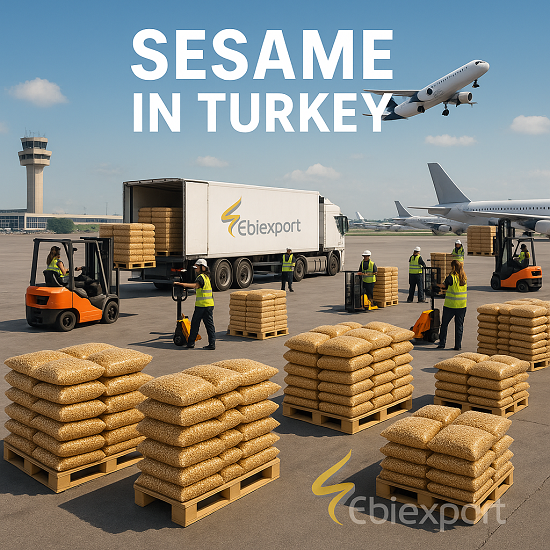
Packaging plays a vital role in sesame exports. Sesame exports from Turkey are packaged to protect against moisture, pests, and contamination. Common formats include polypropylene bags, paper sacks with inner liners, and bulk packaging for industrial buyers.
Logistics planning ensures timely delivery while preserving quality. Proper container loading and ventilation prevent condensation during transit.
These details are essential for maintaining product integrity over long distances.
Exporting sesame requires compliance with international food regulations. Sesame exports from Turkey adhere to standards related to pesticide residues, microbiological safety, and allergen labeling.
Export documentation includes certificates of origin, phytosanitary certificates, and laboratory analysis reports. Labels are adapted to destination country requirements, including language and nutritional information.
This regulatory discipline reinforces trust between Turkish exporters and international buyers.
Buyers seek suppliers who offer reliability, flexibility, and consistent quality. Sesame exports from Turkey meet these expectations through structured sourcing and processing systems.
Türkiye’s trade experience enables exporters to adapt quickly to changing market demands. Competitive pricing combined with dependable supply strengthens long-term partnerships.
Equally important is communication. Transparent processes and responsive service support repeat business.
We approach sesame exports from Turkey with a focus on precision rather than volume. Every batch is assessed for purity, moisture, and uniformity before shipment.
Processing parameters are adjusted based on customer specifications. Packaging and logistics are planned to ensure product arrives in optimal condition.
We do not simply trade sesame. We manage sesame exports from Turkey as a specialized operation, delivering quality at the highest standard.
Global demand for sesame continues to grow, driven by health-conscious consumers and expanding food industries. Sesame exports from Turkey are well-positioned to benefit from this trend.
Investments in traceability, sustainability, and advanced processing will further enhance competitiveness. Buyers increasingly value suppliers who can demonstrate control and transparency.
As markets evolve, sesame remains a stable and valuable export product for Türkiye.
What types of sesame are included in sesame exports from Turkey?
Sesame exports from Turkey include raw, hulled, and roasted sesame seeds prepared for different industrial and retail uses.
Is sesame from Turkey suitable for bakery applications?
Yes. Export-grade sesame meets the purity and uniformity standards required by bakery producers.
Which regions import sesame exports from Turkey?
Europe, the Middle East, Asia, and Africa are primary destinations.
How is quality maintained during sesame exports from Turkey?
Through controlled cleaning, moisture management, standardized packaging, and careful logistics planning.
Why choose sesame exports from Turkey?
They offer consistent quality, processing flexibility, competitive pricing, and experienced export management.