- +90 212 640 55 86
- Mon - Fri: 09:00 - 18:00
- info@ebiexport.com

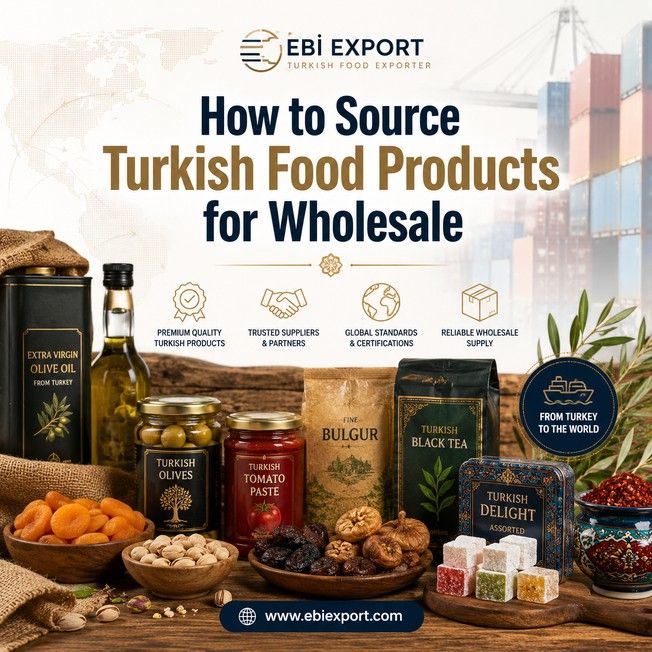
Sourcing Turkish food products for wholesale can be a strong opportunity for importers, distributors, supermarkets, ethnic grocery chains, restaurants, hotels, and food service companies. Turkiye has a deep food culture, wide agricultural production, experienced manufacturers, and a strong export position between Europe, the Middle East, Asia, and North Africa.
But wholesale sourcing is not just about finding a product and asking for a price. That is the easy part. The real work begins when buyers need stable quality, correct packaging, clear documentation, realistic delivery planning, and a supplier who understands international trade.
A Turkish product may look attractive on paper, but if the supplier cannot manage export details properly, the deal can quickly turn into a headache. In food trade, small mistakes become expensive very fast. Wrong labels, weak cartons, missing certificates, unclear shelf life, or poor loading conditions can damage the entire shipment.
That is why international buyers should approach sourcing with a clear plan. Wholesale food supply is not a market walk; it is a structured process.
Understanding the Wholesale Potential of Turkish Food Products
Turkish food products have strong wholesale potential because they offer both tradition and commercial flexibility. Some products are suitable for retail shelves, while others are better for restaurants, bakeries, catering companies, manufacturers, or food distributors.
For example, Turkish olives can be sold in jars, tins, vacuum packs, buckets, or bulk formats depending on the buyer’s market. Turkish kadayif can be supplied for dessert producers, bakeries, restaurants, and wholesalers working with Middle Eastern, Mediterranean, Turkish, and Balkan food categories.
Other Turkish food categories may include dried fruits, nuts, legumes, spices, pickles, sauces, tahini, molasses, confectionery products, bakery ingredients, ready-to-use food items, and traditional regional specialties. Each product group has its own logic. Some depend heavily on shelf life. Some require cold chain. Some need careful packaging. Some are simple to move but competitive in pricing.
The important point is not only choosing a popular product. The product must fit the buyer’s country, customer profile, legal requirements, packaging expectations, and sales channel. A product that sells well in one country may need a different format in another market. Food trade is full of these small but sharp details.
Start with the Right Product Category
Before contacting suppliers, buyers should define what kind of wholesale food products they want to source from Turkiye. This step sounds basic, but it prevents confusion later.
A buyer should decide whether the target is retail-ready packaged food, bulk food supply, private label products, food service items, frozen products, dry goods, traditional Turkish foods, or mixed container shipments.
Retail-ready products need stronger attention to labeling, barcode structure, shelf appeal, carton details, and language requirements. Bulk products are usually more focused on price, volume, quality consistency, and logistics. Private label products require more planning because packaging design, minimum order quantity, production schedule, and legal label details must be arranged before shipment.
If the buyer wants Turkish kadayif, the sourcing process should include product format, storage condition, shelf life, usage area, and packaging size. If the buyer wants Turkish olives, variety, caliber, brine type, packaging material, drained weight, and taste profile become important.
In wholesale food sourcing, product details are not decoration. They are the bones of the deal.
Choose an Export-Ready Turkish Food Supplier
Not every food producer in Turkiye is ready for international wholesale supply. Some manufacturers may have excellent products but limited export experience. Others may understand export documentation but lack flexible packaging options. A good wholesale supplier should be strong on both sides: product quality and export discipline.
An export-ready Turkish food supplier should communicate clearly, provide product specifications, understand shipment terms, support documentation, explain minimum order quantities, and give realistic lead times. If a supplier only says “no problem” to every question, that is usually the first problem.
A professional supplier should be able to answer questions such as:
What packaging options are available for wholesale buyers?
What is the shelf life of the product?
Can the product be supplied under private label?
What are the minimum order quantities?
Which documents can be provided for export?
Is the product suitable for retail, food service, or industrial use?
How is the product stored before shipment?
Can mixed product shipments be arranged?
What are the production and loading timelines?
These questions are not just formalities. They show whether the supplier understands international trade or only domestic sales. Wholesale importers should not gamble with unclear answers. Food sourcing needs clean information, not fog and friendly smiles.
Check Product Quality Before Large Orders
Wholesale buyers should avoid placing large orders before checking product quality properly. Samples, product specifications, photos, packaging details, and shelf life information should be reviewed before moving forward.
For food products, quality is not only about taste. It includes texture, size, color, smell, consistency, weight accuracy, packaging strength, label clarity, carton durability, storage conditions, and batch control.
Turkish olives, for example, should be evaluated according to variety, size, salt level, firmness, packaging type, and target customer preference. A premium retail olive and a food service olive are not always the same product. The market decides the right profile.
Turkish kadayif should be evaluated according to freshness, texture, strand quality, storage requirements, and usage area. A bakery may need a different format than a distributor supplying restaurants. Again, one product name does not mean one standard solution.
Importers should also consider repeat quality. A good sample is important, but the real question is whether the same quality can be supplied again and again. One perfect box does not make a supplier reliable. Repeated performance does.
Understand Packaging Requirements
Packaging is one of the most important parts of sourcing Turkish food products for wholesale. It affects logistics, shelf life, presentation, legal compliance, and customer trust.
For retail products, packaging must look professional and carry the required information for the target market. For food service products, practicality may be more important than visual design. For bulk supply, strength, storage efficiency, and cost become key factors.
Buyers should clarify packaging sizes, inner packaging, outer cartons, pallet structure, labeling language, barcode needs, expiry date format, production date format, storage instructions, and private label possibilities.
Weak packaging can destroy a good product. This is especially true for long-distance shipments. A product may leave the factory in good condition, but if the carton structure is poor, the importer may receive a problem instead of a shipment. Nobody wants to import disappointment by the pallet.
For wholesale sourcing, packaging should be discussed before price is finalized. The same product can have different costs depending on packaging type, label design, carton strength, and order quantity.
Prepare Documentation Early
Food import is a documentation-heavy business. Requirements may change depending on the product, destination country, buyer type, and customs rules. The exact documents should always be checked according to the importer’s local regulations.
In general, buyers may need commercial invoice, packing list, certificate of origin, product specification, health-related documents, ingredient information, shelf life declaration, and other export or import papers depending on the product.
The supplier should be able to explain which documents can be provided. The importer should also confirm requirements with customs brokers or local authorities before shipment. This is one of those areas where guessing is expensive.
Documentation should not be left until the truck is ready. That is how small fires become big fires. A clean export process begins before production, not after loading.
Plan Logistics According to Product Type
Different Turkish food products require different logistics planning. Dry products are usually easier to handle, while frozen or chilled products need more careful temperature control. Fragile products need stronger packaging. Products with shorter shelf life require faster movement and better timing.
Wholesale buyers should decide whether they need full container load, less than container load, mixed container, truck shipment, air cargo, or other transport options. The best option depends on product type, destination, urgency, volume, and budget.
For nearby markets, road transport from Turkiye can be practical. For distant markets, sea freight may be more economical. For urgent samples or small shipments, air cargo may be useful but costly.The main issue is matching the logistics method with product reality. You cannot treat every food product like a box of screws. Food has a clock inside it. Shelf life keeps moving, whether the paperwork is ready or not.
Consider Private Label Options
Many international buyers source Turkish food products not only under existing brands but also under their own private label. This can be a smart move for distributors, supermarket chains, gourmet stores, ethnic markets, and importers who want to build their own brand identity.Private label sourcing from Turkiye can include olives, sauces, pickles, desserts, dry foods, bakery ingredients, and many other food categories. However, private label work needs more preparation than standard wholesale purchasing.
Buyers should prepare label design, target market language, barcode needs, nutritional information format, ingredient declaration, packaging type, carton details, and order volume expectations. The supplier should explain minimum order quantities and production timeline clearly.
Private label can create long-term value, but only if it is managed carefully. A beautiful label on an average product will not save the brand. A good product with poor label compliance may not even reach the shelf. Both sides must work together.
Compare Price with Total Value
Price matters in wholesale trade. Nobody imports products for poetry alone, even if the product comes from a land full of flavor. But price should not be evaluated alone.A cheaper supplier may create hidden costs through weak packaging, unstable quality, delayed production, missing documents, or poor communication. A slightly higher price may be more profitable if it brings reliability, better presentation, and fewer operational problems.
When comparing Turkish food suppliers, buyers should look at the full picture:
Product quality
Packaging strength
Export experience
Documentation support
Production capacity
Communication speed
Order flexibility
Lead time reliability
Private label ability
Long-term supply potential
Wholesale sourcing is not about finding the lowest number on a price list. It is about finding the best commercial balance. The lowest price can become the highest cost if the shipment goes wrong.Work with a Supplier Who Understands International Buyers. International food importers need more than a seller. They need a sourcing partner who understands how wholesale trade works. This includes product selection, packaging, documentation, production planning, shipment coordination, and communication after the order.
Ebi Export supports international buyers looking to source Turkish food products for wholesale markets. The focus is on practical supply, clear communication, and export-ready product solutions from Turkiye. For buyers interested in Turkish kadayif, Turkish olives, and other food products, working with an organized supplier makes the process easier. The goal is not only to buy from Turkiye, but to build a repeatable supply line that can grow with the market.
A good wholesale sourcing process starts with the right questions and continues with careful supplier selection. It includes product checks, packaging planning, document preparation, and logistics coordination. None of these steps should be treated as small details. In food export, the details carry the whole shipment on their back.
Turkish food products have strong potential in global wholesale markets. With the right supplier and a clear sourcing plan, importers can bring traditional and commercial Turkish food categories into their own markets with confidence. Ebi Export works to make this process more structured, more transparent, and more suitable for long-term trade.